A Smith machine gives you a guided path and plenty of confidence under heavy weight. The catch? A single straight bar ties both arms together. Your stronger side can take over a bit more of every rep, and you'd never notice.
The Anvil Handles split that bar in two. Each hand gets its own handle on its own track, so your left and right both have to do their share. Here's what they are, how to add them to your setup, and why they deserve a spot in your program.
How the Anvil Handles Work
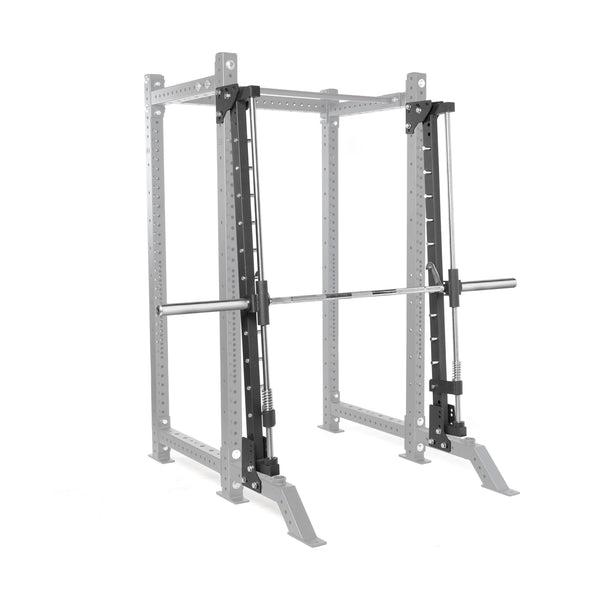
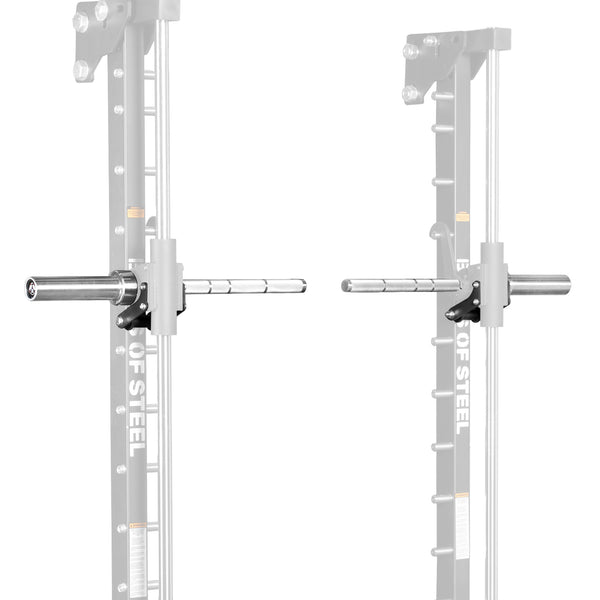
Picture an Olympic bar cut down the middle. Each half rides the Smith rail on its own rollers. It's still the smooth up-and-down feel you know from a Smith, it's just split into two separate paths.
Up close, they look a lot like a real barbell:
- A 29 mm (1 1/8") shaft, a powerlifting-style thickness many lifters love for pressing
- Chrome finish with light knurling
- Rotating 2" / 50 mm sleeves with Olympic-style bushings, so your Olympic plates fit
- 27" / 685 mm overall, with 7 7/8" / 200 mm of loadable sleeve on each handle
Three Ways to Add Them to Your Setup
What you buy depends on what's already in your gym.
- Starting from scratch? Pick up the Smith Machine Rack Attachment and choose the Anvil Handles variant. That gets you the rails, the mounting hardware and both handles together. The attachment fits most racks with 2.3" to 3" uprights, and the product page lists the full compatibility details.
- Already own the B.o.S. BYOB Smith? Grab the handles on their own. They ship with the rollers and mount onto your current BYOB rails.
- Running the Smith with the built-in bar? Choose the converter kit variant. It moves you over to the BYOB setup and adds the handles.
One planning tip: switching the BYOB rails between the Anvil Handles and a straight bar takes a while. You won't want to do it mid-workout, so plan each session around one or the other.
Smoother Travel on Dedicated Rails
Plenty of split-handle designs clamp onto your rack's uprights. These don't. They ride the Smith's own linear bearing rails, and you'll feel it the moment you press. The handles glide smoother, and they stay balanced from your first rep to your last.
Start Your Set From the Top
Each handle has a built-in hook. Unhook it, press, then hook it back on wherever you want to stop, just like you'd rack a normal bar.
Why does that matter? Some iso-lateral handles skip the hook completely. Your safety position doubles as your starting position, so every set begins from the bottom of the rep. Most lifters don't love that. Here, you start in your usual spot and rerack where it suits you.
Why Train Iso-Lateral on a Smith
More range of motion. A straight bar stops the moment it touches your chest. Two separate handles don't, so you can press deeper than a fixed Smith bar lets you.
Balanced work on both sides. Left-to-right strength gaps build up over time for almost everyone. Giving each arm its own track helps even them out.
Less balancing, more muscle. So why not just use dumbbells? It's the same reason you'd pick a Smith over a free barbell. With dumbbells, a chunk of your effort goes into keeping the weight steady. On the rails, you don't have to balance anything, so the muscle you're trying to grow does the work.
Free weights still have their place. A guided path just shines in a few spots. It's great for building muscle and for beginners who are still learning a movement. It's also a solid pick if you've logged years under a barbell and now you're mostly chasing a pump.
Good movements to start with: iso-lateral bench press, iso-lateral shoulder press and single-arm rows.
Weight and Load Capacity
Don't worry about running out of room to load. Each handle takes up to 220 lb / 100 kg, so you've got 440 lb / 200 kg to play with across the pair. The complete set weighs 27.3 lb / 12.4 kg before you add a plate.
Those long sleeves have a second job, too: they make room for bumper plates. Plan on fitting about two bumpers and a collar on each side, and maybe a third, depending on how thick your plates run.
Keep the Bolts Tight
Here's the one bit of upkeep to stay on top of. Check and tighten the bolts regularly, ideally before every session. The same goes for the BYOB Smith.
Your grip width plays a role. A close grip puts more torque through the handles, and over time that torque works the bolts loose. Prefer pressing narrow? Check them more often.
Warranty and Support
The Anvil Handles carry a limited lifetime warranty. Bells of Steel has been in the game since 2010. Need a warranty claim or a spare part years from now? You won't be chasing a company that's disappeared.
When you reach out, you'll talk to the in-house customer service and parts team. They know this gear inside and out, so you'll get answers fast and get back to lifting sooner.
If your stronger side has been carrying more than its share, the Anvil Handles give each arm its own job. Not sure which setup fits your rack? Reach out to the support team before you order and they'll help you sort it out.